Each year, International Day of Education invites us to reflect on how education works — and who it works for. This year’s theme, “The Power of Youth in Co-Creating Education,” highlights an essential truth: young people must be involved in shaping the education systems that affect their lives.
For many young people, especially those who need specialist or alternative support, traditional education simply doesn’t work. Decisions about learning are often made without their input, even though they are the ones most impacted. Too often, education is designed for young people rather than with them. (Woolhouse & Kay, 2023). As a result, many feel unheard, unsupported, and excluded.
At the same time, the world around education is changing rapidly. Schools and services are under increasing pressure to respond to mental health needs, neurodiversity, disability, trauma, digital learning, and widening inequality. Young people live with these challenges every day. Their lived experiences offer insights that policies, frameworks, and institutions alone cannot provide. (Lindsay & Dockrell, 2012).
Co-creating education means recognising that young people are not problems to be fixed. They are partners in shaping solutions. It means listening when they explain what helps them learn, what gets in the way, and what they need to feel safe, included, and able to grow. Inclusion cannot happen without participation, and education cannot be truly equitable unless the voices of those most often excluded are placed at the centre. (UNESCO, 2018).
Education Is a Right — Not a Reward
International Day of Education reminds us that education is a human right, not a reward for fitting into a system that was never designed for everyone.
When education fails to meet a young person’s needs, that is not a personal failure. It is a sign that the system itself needs to change. Real change begins by listening to those who have been excluded and by valuing their experiences as knowledge. (Woolhouse & Kay, 2023).
Why Young People’s Voices Matter
For young people who require specialist support, co-creation is especially important.
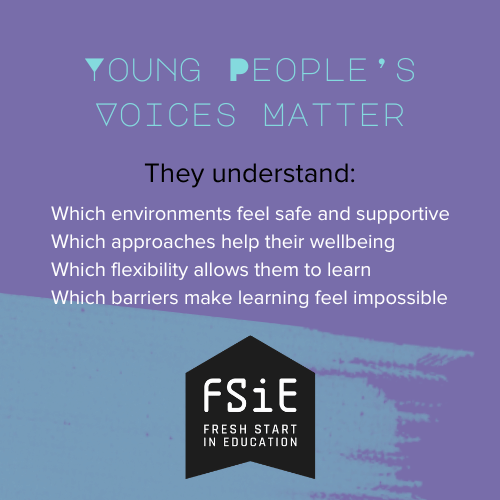
Their voices are not an “extra” or an afterthought. They are essential to creating education that truly works.
When young people are heard, education becomes more responsive, more humane, and more effective. Learning stops being something that happens to them and becomes something they actively shape.
When Education Adapts, Inclusion Becomes Possible
Co-created education recognises that learning does not look the same for everyone. For some, it may mean one-to-one support rather than classroom-based learning. For others, it may involve flexible pacing, creative or therapeutic approaches, or prioritising wellbeing alongside academic progress.
Learning environments also matter. Spaces that are designed around sensory, emotional, or physical needs can make the difference between exclusion and engagement.
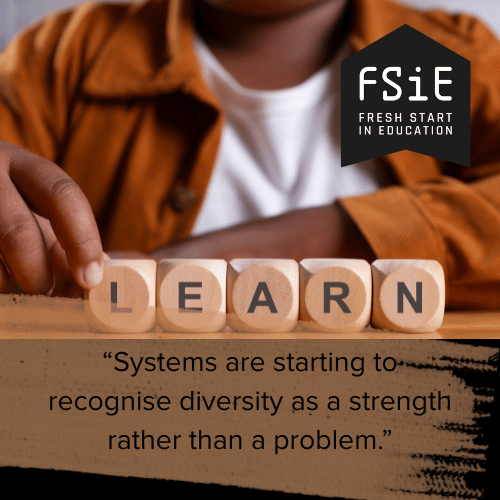
Specialist services and alternative provision are not signs that someone doesn’t belong. They are signs that education is beginning to adapt — and that systems are starting to recognise diversity as a strength rather than a problem.
Lived Experience Is Expertise
Too often, young people who are excluded from education are assessed, discussed, and planned for — but not truly listened to. Their voices are missing from conversations about their own futures.
This year’s theme highlights something powerful: lived experience is a form of expertise. When young people help shape education, systems become fairer and more compassionate. Inclusion improves not because young people change, but because education does.
Our Commitment at Fresh Start
At Fresh Start, this message is at the heart of everything we do. We work with young people who have often been excluded from mainstream education and, too often, labelled as “difficult” or “hard to reach.”
We believe every young person deserves to be understood, not judged. That’s why we take a fully individual, holistic approach. We take time to get to know each young person, listen to their thoughts, understand their concerns, and identify both their barriers to learning and their strengths.
Learning at Fresh Start happens in safe, supportive environments where young people feel respected and valued. From the outset, sessions are student-led. Young people set the pace, choose activities, and communicate what they feel comfortable doing. This approach builds confidence, independence, and a sense of control over their learning.
We don’t see differences as weaknesses. We see them as strengths. With the right support, those strengths can empower growth and success. Education at Fresh Start isn’t just about academic progress — it’s about building confidence, fostering self-expression, and creating a sense of belonging.
Education Must Grow With the Learner
Education is not fixed, and it should never be one-size-fits-all. Progress does not follow a single path or timeline. For some young people, learning begins with rebuilding trust, emotional safety, or confidence before academic learning can even take place.
When education is flexible and responsive to the individual, it becomes more inclusive and more effective. It allows learning to pause, restart, or take a different form when needed.
Ultimately, education should grow with the learner. When education is allowed to be human, adaptable, and shaped by young people themselves, it becomes a powerful tool for inclusion, opportunity, and hope.
References
- Lindsay, G., & Dockrell, J. (2012). Student voice for promoting inclusion in primary schools. International Journal of Inclusive Education, 16(5), 455–471. https://doi.org/10.1080/13603116.2011.585015
- UNESCO. (2018). Empowering learners, transforming schools: Meaningful youth engagement handbook. UNESCO.
- Woolhouse, C., & Kay, V. (Eds.). (2023). Championing co-production in the design of inclusive practices: Positioning children and young people’s voices at the heart of education. Routledge.