Why “safe enough” may be the most important step in trauma recovery
“You are safe now.”
It’s a phrase often offered with kindness and reassurance. Yet for many people who have experienced trauma, bullying, abuse or chronic adversity, those words can feel strangely disconnected from reality.
Not because the danger still exists, but because the body hasn’t yet recognised that it has ended.
One of the most powerful concepts within Protective Behaviours is that feeling safe and being safe are not always the same thing. This distinction is fundamental to understanding trauma and supporting recovery. While our circumstances may have changed, our nervous system can continue responding as though danger is ever-present.
Rather than asking someone to simply “move on” or “let it go”, perhaps we need to ask a different question:
What would help someone feel safe enough today?
For many people, that question is far more compassionate – and far more helpful.
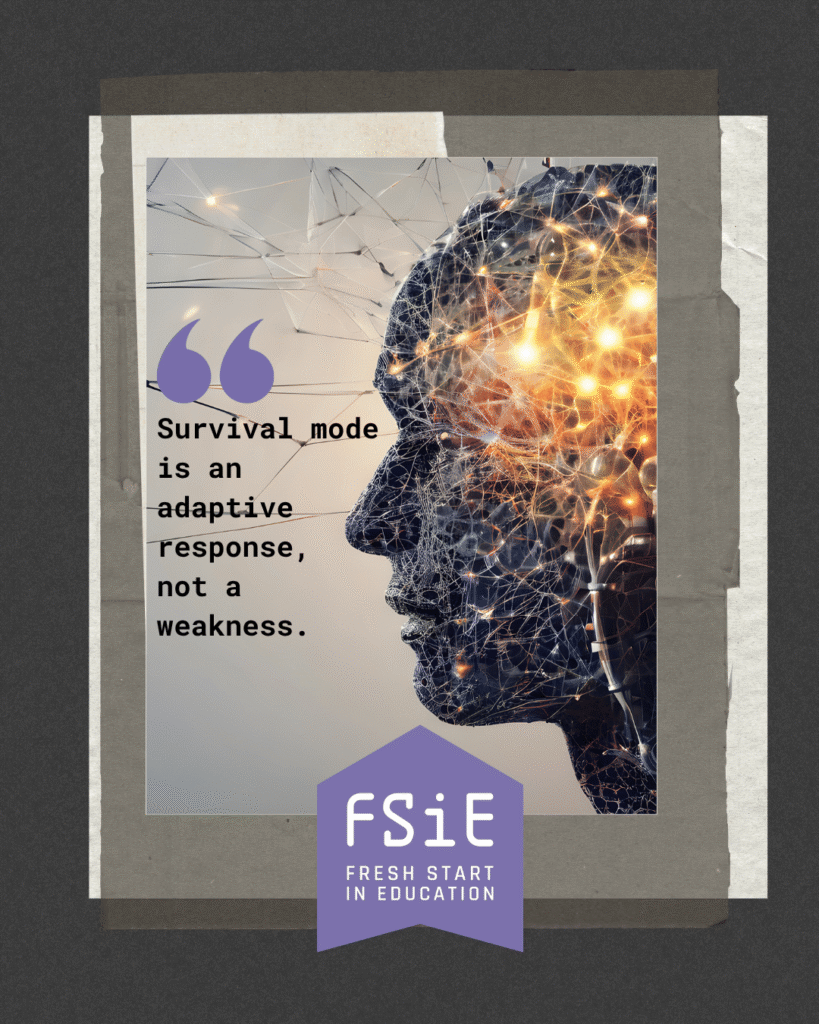
Survival mode is an adaptive response – not a weakness
Protective Behaviours begins with one of its most powerful themes:
We all have the right to feel safe all the time.
For some, those words feel reassuring.
For others, they feel almost impossible to believe.
Individuals who have experienced repeated bullying, domestic abuse, neglect, discrimination or other traumatic experiences often learn that feeling unsafe becomes their normal. Hypervigilance, avoidance, emotional shutdown, people-pleasing and constantly anticipating the worst are frequently misunderstood as behavioural difficulties or anxiety disorders.
In reality, these responses are often remarkable examples of human adaptation.
The brain is doing exactly what it has evolved to do – protect us from perceived danger.
When someone has lived through trauma, their nervous system becomes highly skilled at spotting potential threats. That survival response may once have been essential. The difficulty arises when the nervous system struggles to recognise that circumstances have changed.
Even when life becomes objectively safer, the body may continue reacting as though danger is still just around the corner.
This invites us to replace judgement with curiosity.
Instead of asking,
“What’s wrong with this person?”
we begin asking,
“What has happened to this person, and what is their body trying to communicate?”
That simple shift transforms how we support others and how we understand ourselves.
It replaces blame with compassion.
It reminds us that survival strategies are not character flaws – they are evidence of a nervous system that has worked incredibly hard to keep someone safe.
Listening to our Early Warning Signs
A cornerstone of Protective Behaviours is recognising our Early Warning Signs (EWS).
Our bodies often detect potential danger long before our conscious mind catches up.
A racing heart.
Tight shoulders.
A knot in the stomach.
Holding our breath.
Feeling frozen.
Wanting to escape.
Difficulty concentrating.
A sudden urge to people-please or withdraw.
These physiological responses are not problems to eliminate; they are valuable sources of information.
This encourages us to become curious rather than critical.
One of its most memorable messages reminds us:
Our feelings don’t tell us what to do. They tell us to think.
Feeling anxious doesn’t automatically mean we are unsafe.
Equally, ignoring our feelings because “everything is fine” disconnects us from valuable information.
Instead, we can pause and ask:
- What am I noticing?
- What might my body be responding to?
- Is this a current risk or a reminder of a past experience?
- What would help me feel safe enough right now?
Those questions create a pause between fear and action.
Rather than reacting automatically, we gain the opportunity to respond thoughtfully.
Sometimes the answer might be setting a boundary.
Sometimes it might be stepping outside for fresh air, grounding ourselves in the present or reaching out to someone we trust.
Sometimes, simply recognising that our nervous system is remembering something our conscious mind has already moved beyond is enough to reduce its intensity.
Safety grows in relationships, not isolation
Protective Behaviours’ second theme reminds us:
Nothing is so awful that we can’t talk about it with someone.
This isn’t simply about disclosure.
It’s about recognising that one of our greatest protective factors is human connection.
Trauma has a way of convincing us that we are alone. It tells us that nobody will understand, that asking for help is a burden or that we simply have to cope.
This gently challenges those beliefs.
Recovery happens in relationships.
Looking back on my own journey, I can see that while Protective Behaviours gave me the language to understand safety, it was the people around me who helped me experience it.
My parents became my constant.
Through every setback, every difficult day and every moment when I questioned whether I could keep going, they never stopped believing in me. They celebrated the smallest victories, reminded me of my strengths when I had forgotten them myself and gave me the confidence to keep putting one foot in front of the other.
They didn’t try to fix everything.
Instead, they gave me something even more powerful – a secure base from which I could slowly rebuild my confidence.
They are the reason I have become the person I am today.
Within school, I was equally fortunate to have trusted adults who embodied the very principles that Protective Behaviours encourages us to be.
My Year Head’s office was rarely quiet. Whether there were five young people waiting or fifteen, she always found time to listen. She had an extraordinary ability to make every student feel seen and valued. In a school where I often felt invisible, her consistency reminded me that there was always someone willing to notice.
I wasn’t simply another student walking through the door.
I was a young person whose feelings mattered.
Looking back, she wasn’t just offering support – she was creating psychological safety.
Alongside her was my mentor, someone with an extraordinary ability to turn every frown upside down.
She met me where I was, never where she expected me to be.
On the days when anxiety threatened to overwhelm me, she stood beside me with unwavering patience, quiet encouragement and genuine belief. She celebrated every small step, however insignificant it may have appeared to others.
She didn’t remove my fears.
She helped me believe I was capable of facing them.
Her calmness became something I could borrow until I gradually found my own.
Reflecting now, I realise these relationships were never just acts of kindness.
They were protective factors.
They modelled trust, consistency, empathy and connection.
Most importantly, they taught me that I didn’t have to navigate difficult experiences alone.
The power of “safe enough”
Recovery is rarely about suddenly feeling completely safe.
For many people living with trauma, that expectation feels overwhelming and unrealistic.
Instead, Protective Behaviours offers us something much gentler.
The opportunity to notice moments where we feel safe enough.
Safe enough to walk into the room.
Safe enough to ask for help.
Safe enough to stay for another five minutes.
Safe enough to trust one person.
Safe enough to have the difficult conversation.
Safe enough to try again tomorrow.
Those moments may seem small, but they are neurologically significant.
Each one provides fresh evidence to the brain that not every situation ends in harm.
Over time, those repeated experiences begin to reshape our expectations of the world.
Healing is built through repetition, not revelation.
Dynamic risk assessment: empowering rather than rescuing
Protective Behaviours is sometimes misunderstood as a programme about avoiding risk.
In reality, it equips people to manage risk with confidence.
It encourages us to notice our Early Warning Signs, assess situations thoughtfully, identify protective strategies and consider who can support us.
Rather than asking someone to be fearless, it asks:
What would help you feel safe enough to take the next step?
That question is incredibly empowering.
It recognises that courage isn’t the absence of fear.
It’s the willingness to move forward while respecting what our nervous system is telling us.
Instead of rescuing people, we help them build confidence, autonomy and resilience through informed decision-making.
From surviving to living
Trauma recovery is rarely linear.
There will still be days when old memories resurface and my Early Warning Signs appear unexpectedly. Progress is not measured by never feeling anxious again. Progress is measured by recognising those feelings, understanding what they are communicating and knowing that I no longer have to face them alone.
This teaches us that safety is not a destination we eventually reach. It is something we build every day through awareness, trusted relationships, healthy boundaries and compassionate conversations.
Looking back, I now understand that my journey from survival mode wasn’t one I walked alone.
It was shaped by parents who never stopped believing in me, giving me the love and encouragement that became the foundation of my resilience.
A Year Head who always found time to listen, no matter how busy she was.
A mentor who reminded me, day after day, that there was still hope to be found and somehow always managed to turn my frown upside down.
Years later, my PB Lady introduced me to Protective Behaviours, helping me understand my trauma through a completely different lens. Instead of asking, “What’s wrong with me?” I began asking, “What happened to me? What are my Early Warning Signs telling me? What helps me feel safe enough?”
That shift marked the beginning of my healing journey.
Today, I continue to live with the long-term effects of trauma, including a chronic illness. Protective Behaviours hasn’t erased those challenges, but it has transformed how I understand and respond to them – with greater self-awareness, self-compassion and confidence.
Perhaps the greatest privilege is that my journey has come full circle.
Inspired by my PB Lady, I am now a licensed Protective Behaviours Trainer, supporting children, young people, families and professionals to discover the same framework that transformed my own life. Every workshop I deliver reminds me why this work matters. Every conversation about Early Warning Signs, trusted relationships and feeling safe enough has the potential to change someone’s understanding of themselves, just as it changed mine.
That is the true power of Protective Behaviours.
It doesn’t promise that life will become free from challenges.
It doesn’t suggest that trauma can simply be forgotten.
Instead, it offers something far more realistic and far more hopeful.
It gives us permission to understand ourselves with compassion rather than criticism.
It reminds us that our feelings are meaningful, our relationships matter and that healing doesn’t happen through perfection – it happens through connection.
Perhaps that is the greatest lesson Protective Behaviours has taught me.
Survival may have protected me.
But the unwavering support of my family, the trusted adults who believed in me, the guidance of my PB Lady and the principles of Protective Behaviours helped me move from surviving to living – from simply existing in survival mode to finally feeling safe enough.