There are many different types of eating disorders that people can suffer from. Avoidant Restrictive Food Intake Disorder (ARFID) is one of the least understood and studied.
According to the East London NHS Trust, “There is currently no solid data for how many people in the UK have ARFID as it is very often conflated with “fussy” eating; however, in a systematic review of 30 studies, the estimated prevalence of ARFID in child and adolescent samples ranged between 0.3% and 15.5%.”
Although many people with ARFID can present as being underweight, some individuals can become obese as they become fixated on unhealthy foods and will not tolerate anything other than for example crisps and chocolate etc.
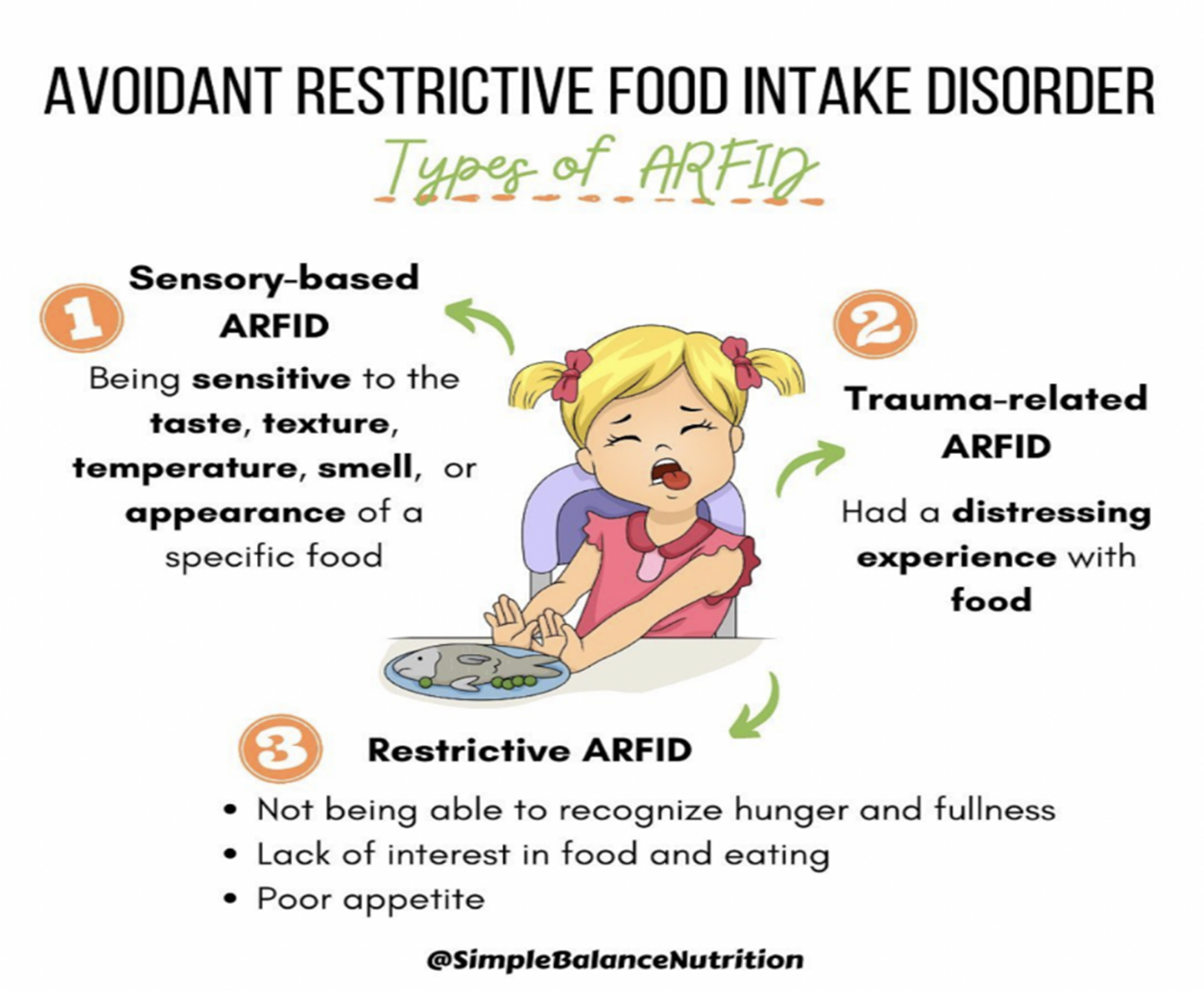
As a person with ARFID can present as being either underweight or obese, it can be difficult for the individual and the families to explain. This can present as the child not just being fussy but actively making poor food choices which can cause difficulties in education provisions as most establishments now have healthy eating policies, and the individual may be singled out for poor food choices especially in packed lunches.
It is important to note that individuals can share some of the aspects of the different types of ARFID, but will mainly fall within one; however, this can change over time, especially with trauma based ARFID as the individual may have been masking the initial cause.
ARFID – Possible Signs and Symptoms
Below are some of the signs and symptoms that someone who has ARFID can display. This is not an exhaustive list and can vary significantly between individuals. It’s not just ‘fussy’ eating! ARFID:
- Often co-occurs with Anxiety and/or Autism
- Can cause fatigue and/or excess energy
- Can be linked to sensory processing difficulties
- Can cause fears such as fear of choking, can also cause you to feel full or experience digestive pain
- Is not linked with body image or desire to lose weight
- Can cause a disinterest in food
- May cause a person to have a select few ‘safe’ foods
- May cause a person to have anxiety relating to eating
- Can cause significant weight loss
- May cause a person to avoid situations where they’ll be food or expectation to eat
Student Voice
This is what Fresh Start student Elly, who has ARFID, would like people to understand about the condition:
“If you have ARFID, you know your diet is unhealthy and it is not good for you and that you should be eating more or eating more of different things but you cannot control it. What you eat is all you can eat and it’s better than starving.”
“I have less interest in food than others, I really don’t want to eat, as it’s not really nice, it is such a chore, sometimes it’s nice if the food is tasty but I’d rather not eat if I don’t feel like it. “
“I would rather snack, eating is not very nice”
“Thinking about what to eat is too much – think I am too lazy.”
“(Eating)Might stop me going places – I do go to restaurants as a get-together, as I do not want or can’t eat as most things have gluten. The gluten free options are not tasty and then I worry about cross contamination.”
“Don’t like having to see and hear people eat, it is gross and pointless as I can’t eat.”
Top tips for being and working with people with ARFID
- Do not highlight attention to food and eating, do not make it a big thing.
- Have different options of venues to go to for a meal, consider options when it is quieter.
- Be flexible because having ARFID means that you could eat the same food for a month and then may change.
- Part of ARFID is the predictability of size, shape, texture, smell, and taste so ARFID people would prefer to eat the same brand, alternatives are not an option; for example they could not swap out Bird’s Eye nuggets for a supermarket own brand.
- Making their own food can also be difficult as the ingredients can be as much of a trigger as the finished meal.
- Also homecooked food is not acceptable as although you may use the same ingredients, the end result may not be exactly the same as before.